
The simple explanation
It watches for electricity flowing where it should not.
An RCD continually compares the current flowing out through the live conductor with the current returning through the neutral. If enough current is leaking away—possibly through damaged equipment, faulty wiring or a person—it rapidly disconnects the supply.
This additional protection can significantly reduce the risk of fatal electric shock, but it does not make unsafe equipment safe and it cannot protect against every possible type of contact.
Know the devices
Fuse, MCB, RCD and RCBO are not interchangeable names.
Protects cables against overload and short-circuit current.
Can protect several circuits and disconnects when leakage is detected.
Provides overcurrent and residual-current protection to an individual circuit.
What the devices look like
Look for the rating and the test button—not only the switch colour.
Manufacturers use different shapes and colours. These simplified examples show the clues normally visible through the consumer unit’s hinged flap.
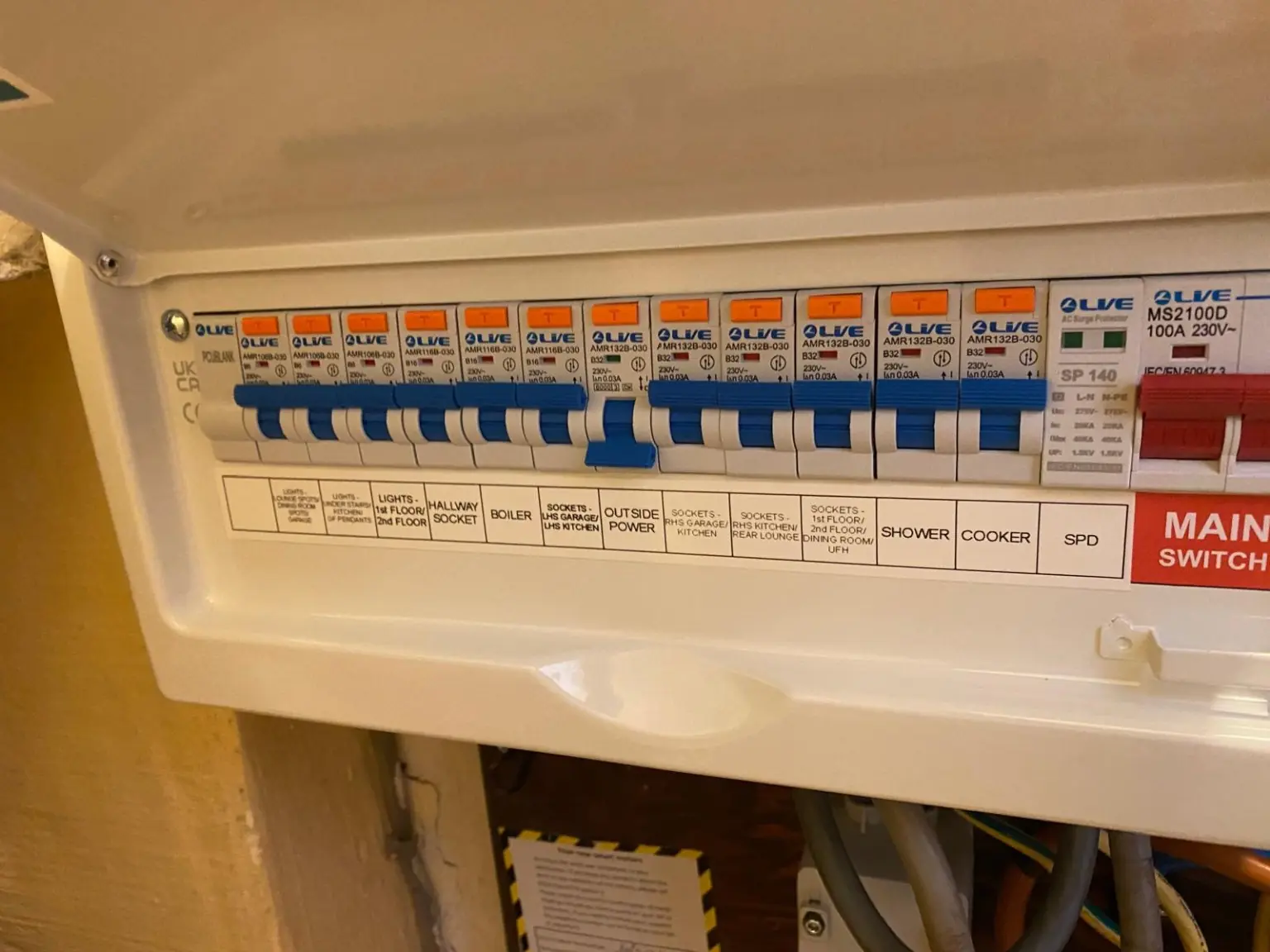
Each blue circuit switch has its own orange test button. The surge protective device and red main switch are on the right. Labels underneath identify every circuit.
Never remove the screwed cover. Open only the normal hinged flap intended for the user.Important: a button or label helps identify a device, but it does not prove which circuits it protects or whether it operates correctly. Follow the manufacturer’s label and arrange electrical testing where protection is uncertain.
The test button
Pressing “T” or “Test” checks the device can operate.
- Tell everyone in the property—the protected circuits will switch off.
- Prepare computers, alarms and equipment that should not lose power unexpectedly.
- Press the button marked “T” or “Test”. The RCD should switch off.
- If it does not operate, or will not reset afterwards, arrange professional advice.
The button checks the mechanism; it is not a substitute for an electrician testing the operating current, disconnection time and the circuits it protects.
No RCD—or unsure?
Do not assume an old fuseboard provides the same protection.
Some older installations have no RCD protection, while others protect only some circuits. A photograph with the normal hinged flap open can often help identify the devices fitted. Never remove a screwed cover or touch anything inside.
Missing RCD protection does not automatically prove the entire installation needs rewiring. The right next step may be an assessment, an EICR, targeted remedial work or a consumer-unit upgrade depending on the installation and planned work.
Common questions
What homeowners usually ask.
Is an RCD the same as a circuit breaker?
Not exactly. A circuit breaker or fuse protects wiring against overload and short-circuit current. An RCD responds to current leaking away from the intended path, which may indicate a risk of electric shock. An RCBO combines both forms of protection for one circuit.
Why does my RCD keep tripping?
Possible causes include a faulty appliance, moisture, damaged wiring, a fault on a circuit or combined leakage from several items. Repeated tripping is a warning to investigate—not a reason to hold the device on or bypass it.
Does an RCD make electricity completely safe?
No. An RCD is important additional protection, but it cannot prevent every shock or replace safe wiring, correct earthing, suitable circuit protection and proper electrical work.